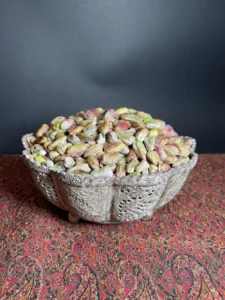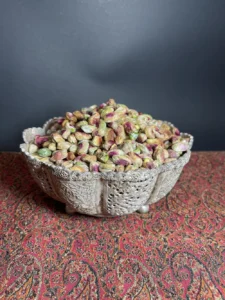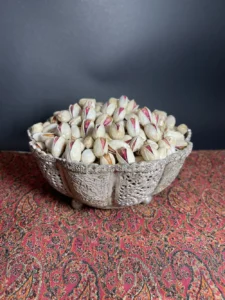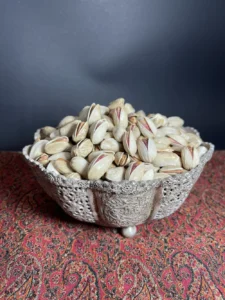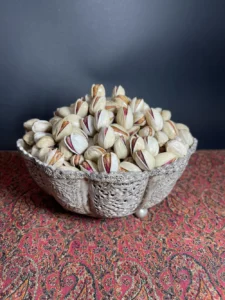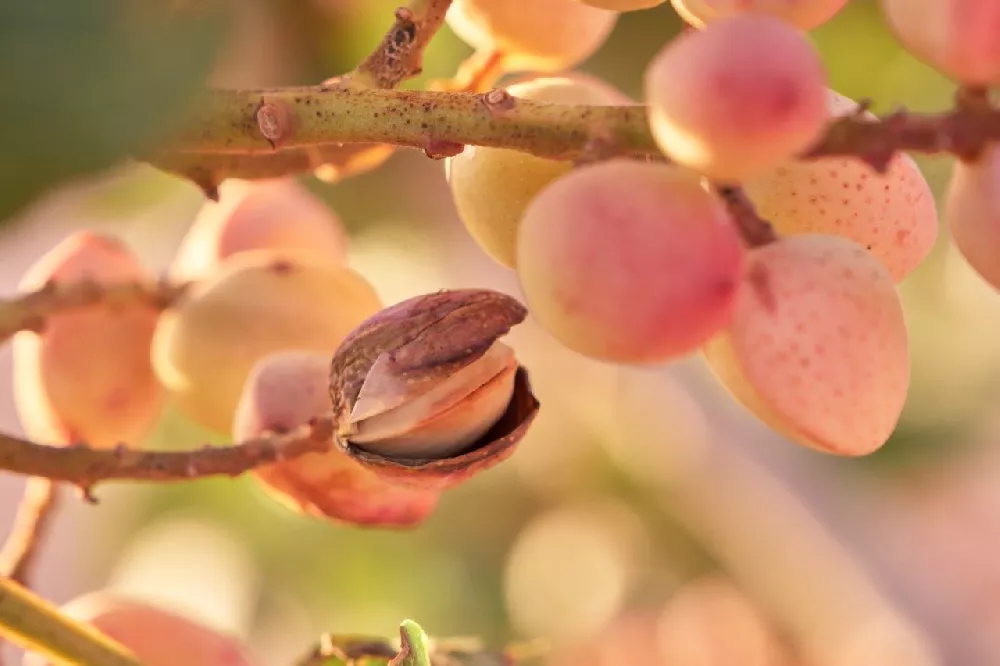
Characteristics of pistachio cultivars in Iran: About 90 cultivars are known, some of which are cultivated widely and commercially and some are cultivated sporadically and on a limited scale. The characteristics of the most important commercial pistachio cultivars are presented below:
Ohadi cultivar: One of the most important commercial pistachio cultivars, very well known and adaptable in most pistachio-growing regions, and it includes 60–70 percent of pistachio orchards in Rafsanjan. Tree height is about 3 meters, with moderate growth and a wide canopy. The majority of its leaves are compound with three leaflets, and the terminal leaflets are larger than the lateral leaflets. Terminal dominance is very high, and most leaves are compound. It has medium flowering, is early-maturing, and has moderate alternate bearing. It can be harvested in the first decade of September.
Kalleh Ghouchi cultivar: Relatively high yield and large, round nuts were the main factors for its selection and expansion. It has stronger and more rigid branches compared to Ohadi. It is more sensitive to water and nutrient deficiency. In most years, due to early flowering, especially in cold regions, it is exposed to the risk of spring frost. It is mid-maturing and has moderate alternate bearing. It has lower terminal dominance and a greater ability to produce lateral branches. Seedlings obtained from this cultivar are resistant to boron toxicity. It can be harvested in the second decade of September.
Ahmad Aghaei cultivar: One of the commercial cultivars with almond-shaped nuts, white shell, and large nut size, which is expanding. It has medium flowering and is late-maturing, with the highest intensity of alternate bearing, which can be largely controlled if proper orchard management is applied.
Akbari cultivar: One of the commercial pistachio cultivars and economically has the highest value. Its nuts are almond-shaped, elongated, and large. Characteristics of this cultivar include high vegetative growth with dense veins and large leaf surface, good yield, late flowering, and late maturity. It can be harvested in the third decade of September and suffers more damage from heat stress.
Badami Zarand cultivar: The nut of this cultivar is almond-shaped, small, dagger-like, and has a dull color. Its origin is from old pistachio orchards located in the Zarand region of Kerman. The majority of its leaves have five leaflets. It is an early-flowering cultivar and one of the very early-maturing cultivars and can be harvested in the first half of August.
Khanjari Damghan cultivar: This cultivar is one of the commercial pistachio cultivars of the Damghan region, and its nut is almond-shaped. The majority of its leaves are compound with three leaflets, and the terminal leaflet is larger than the lateral leaflets. It is a late-flowering and mid-maturing cultivar and can be harvested in the second decade of September.
Mumtaz cultivar: The nuts of this cultivar are almond-shaped, and its kernel is tastier than other commercial cultivars. The majority of its leaves are compound with three leaflets. It is an early-flowering cultivar and can be harvested in the third decade of September, and it is considered among early-flowering and late-maturing cultivars.
Sefid Pistachio of Nogh cultivar: This cultivar has existed in the Rafsanjan region since ancient times, especially in the Nogh region, which has a warmer climate compared to Rafsanjan, where it has expanded more. The nut of this cultivar is almond-shaped and early-flowering, can be harvested in the third decade of September, and is considered a late-maturing cultivar.
Shahpasand cultivar: This cultivar is also one of the commercial pistachio cultivars in the Damghan region, and its nut is almond-shaped. The majority of its leaves are compound with three leaflets. It is a late-flowering cultivar and can be harvested in the second decade of September and is considered a mid-maturing cultivar.
Qazvini pistachio cultivar: Its origin is the Qazvin region, where it is known as Kaleh Bozi pistachio. Its nut is almond-shaped, small, and has a relatively green kernel. The number of nuts present in each cluster is very high. The majority of its leaves are compound with three leaflets. It is a late-flowering cultivar and can be harvested in mid-August and is considered one of the very early-maturing cultivars.
Different pistachio cultivars have differences in flowering time, and they can be divided into three categories:
Early-flowering cultivars: Italian, Sefid Pistachio of Nogh, and Kalleh Ghouchi
Medium-flowering cultivars: Ohadi, Ahmad Aghaei, and Badami Zarand
Late-flowering cultivars: Ebrahimi, Jandoghi, Qazvini, and Akbari
Diversity of pistachio cultivars in terms of flowering allows selecting a cultivar that causes the least damage to flowers and pollination status, considering late frost, rainfall, and early spring heat, which are considered limiting climatic factors.
The flowering time of different cultivars is influenced by environmental conditions, including regional climate, nutrition and fertilization method, irrigation, and soil texture.
The start time of rapid kernel growth of different cultivars is from late June to late July, and the time required for completion of kernel growth varies between 25 and 45 days. Different cultivars have differences in harvest time, and they can be divided into the following five groups:
Very early-maturing cultivars (up to August 31): Early Fandoghi, Early Rezaei, Very Early Qazvini, and Very Early Italian
Early-maturing cultivars (September 1–10): Mosa Abadi, Ohadi, Early Qazvini, Early Italian
Mid-maturing cultivars (September 11–20): Kalleh Ghouchi, Sirizi, Nish Kelaghi, Khanjari Damghan, Shahpasand, Amiri, Seyfoddini, and Badami
Late-maturing cultivars (September 21–31): Hasanzadeh, Badami Zarand, Ahmad Aghaei, Fandoghi Ghafoori, Akbari, Small Fandoghi, Badami Ravar, Herati, Mumtaz, Sefid Pistachio of Nogh, Ebrahim Abadi, Gholamrezaei
Very late-maturing cultivars (October 1–10): Fandoghi 48, Ebrahimi, and Jandoghi
In early-maturing cultivars, kernel filling starts earlier and is completed in a short period, and in late-maturing cultivars, kernel completion time is longer.
One of the factors of embryo abortion and blank nuts at the end of the growing season is the effect of high temperatures at this stage of fruit growth, which leads to embryo abortion. Therefore, according to existing climatic conditions, cultivars can be selected so that kernel growth time does not coincide with severe heat.
Early-maturing cultivars can be harvested in the second half of August, and very late-maturing cultivars in late October.
The cultivated area of very early-maturing cultivars is limited, and they are mostly consumed fresh. Early-maturing cultivars are suitable for regions with a short growing period.
Late-maturing cultivars are not suitable for regions where the probability of early autumn frost or autumn rainfall exists and become contaminated and have undesirable quality.
Most important pistachio rootstocks: Rootstock selection is one of the most important issues that must be considered when establishing a pistachio orchard. Although all pistachio scions can be grafted onto different species, in Iran three pistachio species—cultivated pistachio (P. vera), Chatlanqush (P. khinjuk), and Baneh (P. mutica)—are used as pistachio rootstocks.
In more than 99 percent of pistachio orchards, the cultivated species is used as the rootstock. This species has very high genetic and phenotypic diversity in different regions of Iran.
Its initial growth is high and it has good compatibility with different scion cultivars, but it is sensitive to root-knot nematode, gummosis, and verticillium.
The Baneh rootstock is known as one of the pistachio rootstocks resistant to root-knot nematode, and Chatlanqush is known as a rootstock resistant to drought and water shortage.
In other countries of the world, other rootstocks such as P. terebinthus, P. atlantica, P. integerrima, UCBI, PGI, and PGII are used. The latter three rootstocks are obtained from interspecific hybridization between P. integerrima × P. atlantica and are sold under commercial names.
P. atlantica: Due to higher resistance to cold compared to P. integerrima, it is the most common rootstock used in the state of California. In recent years, due to the spread of verticillium disease, rootstocks resistant to it such as P. integerrima and its hybrids have been used.
P. integerrima: The most sensitive rootstock to cold. Nutritional research has shown that the efficiency of this rootstock in boron uptake is lower than P. atlantica. After it was determined that this rootstock is resistant to verticillium disease, its use expanded in newly established orchards in California.
Interspecific hybrids: Hybrid rootstocks UCBI and PGII differ in the level of resistance to verticillium. P. integerrima is the most resistant rootstock, and P. atlantica is the most sensitive rootstock to verticillium disease.
Also, the UCBI hybrid rootstock is semi-resistant to resistant, and the PGII hybrid rootstock is semi-sensitive to sensitive.
The PGII rootstock has relatively higher efficiency in zinc uptake compared to P. terebinthus, while P. atlantica is in the middle of them, and UCBI and P. integerrima rootstocks have the lowest uptake.